Steve Roder on 40 Years of LISTSERV at the University at Buffalo
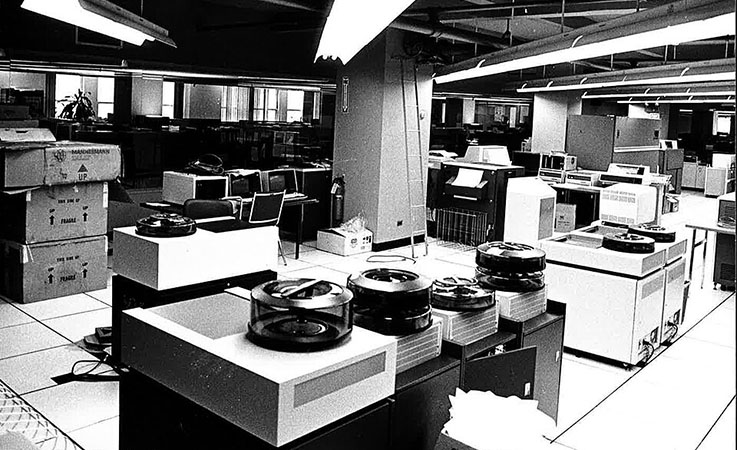
Photo: Jonathan Schilling, 1983 · CC BY-SA 4.0 · Cropped from Original
In 1988, a young systems administrator named Steve Roder sprinted down a hallway at the University at Buffalo in upstate New York with one thought in mind: get to the machine room before the whole system chokes.
The problem wasn't a virus, a hacker or a power outage. It was email – too much of it. UBVM, the university's IBM mainframe, had hit its spool file limit of 9,900 files. LISTSERV, the automated mailing list software introduced only two years earlier, was generating traffic faster than the system could hold it.
"I do recall many times having to dump spool files to tape to free up the LISTSERV queues, to then be reloaded after the traffic jams cleared," Roder said.
This is not just a story of one administrator's career, but of how a scrappy academic network turned a Buffalo mainframe into a global switchboard and taught an entire generation what online community actually meant, years before anyone had heard of a social network.
|
||||
In 1986, if you wanted to connect with people who shared your interests or technical challenges, you didn't open an app. You subscribed to a mailing list.
The infrastructure that made this possible was BITNET – "Because It's Time Network" – a cooperative network connecting universities across the world through email and electronic messaging. The University at Buffalo joined early. Rick Lesniak, who wrote UB's BITNET application in 1985, remembers the moment the potential became obvious.
"People were starting to form these new types of communities. Everybody saw that there was a real advantage here."
What the University at Buffalo didn't yet have was a way to manage those communities at scale. Every subscription request, removal and address change required human intervention. That bottleneck was about to disappear.
In 1986, a student in France named Eric Thomas built LISTSERV, a software program that automated the management of electronic mailing lists and made it possible for communities to grow on a scale that had previously been difficult to sustain. UB staff started collaborating with Thomas that same year on a peering model that allowed LISTSERV data and mailing list traffic to move more efficiently across BITNET's growing network.
University at Buffalo didn't just adopt the technology, it became one of its heaviest users. UBVM emerged as a "mid-level core" node for the Northeastern United States, and, according to Lesniak, one of the highest-volume LISTSERV sites anywhere, with a reputation that stretched across the Pacific Rim.
Which brings us back to Steve Roder and those spool files.
Jim Gerland, a member of UB's User Support team, had brought LISTSERV to the university. Roder, who took over responsibility for the VM system in February 1986, was pulled into its orbit almost immediately.
"Over the next several years, with the exploding BITNET network, we handled millions of files passing through our system, most of it LISTSERV traffic. Due to the impact it could have on the system, I became more involved."
Bandwidth in the 1980s wasn't built for this kind of load, so maintaining the system required a lot of work. It also placed Roder at the center of one of the fastest growing communication networks of its era.
"LISTSERV and UB's role in BITNET put UBVM on the map. People I would meet at conferences knew me from UBVM."

Steve Roder in his office in 1996
The mailing lists that Roder frequented weren't just technical utilities. They were communities where a tight-knit world of IBM VM programmers exchanged ideas and expertise. Because much of the VM operating system was distributed as source code, collaboration was deeply embedded in the culture. Knowledge-sharing happened daily through mailing lists and professional workshops.
Roder started as a lurker.
"I was mainly a reader on the many VM-specific LISTSERV discussion groups."
Over time, reading turned into participation, and participation turned into recognition.
"When at conferences, people I would meet would see my badge. I would get comments like: 'Steve Roder, I know you, from UBVM.'"
As LISTSERV grew from research project into the backbone of L-Soft's commercial software, the University at Buffalo and Thomas continued to collaborate. One result was an arrangement that gave Thomas and L-Soft continued access to UBVM for development in exchange for the university running L-Soft's products free of charge.
For Roder, it was more than just a technical arrangement.
"It was flattering to have Eric Thomas using 'my' VM system in this way, as in my early VM days, he was someone whose knowledge I deeply respected. To feel I was now somewhat of a peer was awesome."
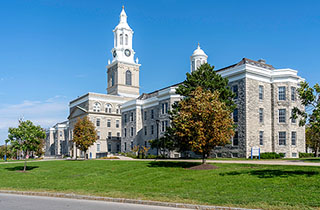
The University at Buffalo in New York
LISTSERV at UB has since migrated from VM to Solaris, then Linux, then Windows – but it never stopped running. The university still relies on it today for academic, administrative and community communication. Roder remains subscribed to several long-running lists, including ADSM-L, focused on IBM enterprise backup technologies.
Looking back on a 45-year IT career, he credits LISTSERV and UBVM's role at the center of BITNET with helping shape his professional life. But the technology's real legacy, he says, isn't infrastructure. It's people.
"Ask a question, and you would get an answer, or several."
Those exchanges created something that lasted far beyond software releases and hardware upgrades.
"Relationships were also built here and made seeing the people at a conference more like a reunion than a 'nice to meet you' event," Roder said.
Forty years on, that's the part worth remembering. Platforms change. Mainframes get retired. And spool files stop overflowing.
But the instinct to find your people, share knowledge and build something together remains remarkably familiar.
L-Soft gratefully thanks Steve Roder, Senior Systems Administrator at the University at Buffalo, for sharing his memories, experiences and insights from four decades of working with UBVM, BITNET and LISTSERV. His reflections provide a unique firsthand perspective on the growth of online communities, academic networking and the evolution of digital communication.
Historical background and contextual information for this article were drawn from:
David J. Hill, "Email List Software Marks 25 Years"
UB Reporter, October 10, 2011
https://www.buffalo.edu/ubreporter »
University at Buffalo, LISTSERV Service Information
https://listserv.buffalo.edu »
University at Buffalo UBIT, LISTSERV for Group Email
https://www.buffalo.edu/ubit »
For readers interested in exploring the history further:
Eric Thomas and the History of LISTSERV
https://www.lsoft.com/resources »
BITNET (Wikipedia)
https://en.wikipedia.org/wiki/BITNET »
VM (Operating System) (Wikipedia)
https://en.wikipedia.org/wiki/VM »
BITNET (1981-1996) – A pioneering academic network that connected universities worldwide and enabled email, file sharing and discussion groups before the modern Internet became widely available.
LISTSERV (1986-) – Developed by Eric Thomas in 1986, LISTSERV automated the management of electronic mailing lists and helped create some of the world's earliest large-scale online communities.
UBVM – The University at Buffalo's IBM VM mainframe environment. During the growth of BITNET, UBVM became an important node for academic and LISTSERV-related network traffic.
Eric Thomas – The French engineering student who created LISTSERV in 1986 and later founded L-Soft, the company that continues to develop LISTSERV software today.
Peering – A method that allowed multiple LISTSERV servers to share and synchronize mailing list data, helping distribute network traffic more efficiently as email communities expanded internationally.
Was this article helpful to you? Would you recommend it to a colleague? Your input helps us create content that truly supports your work. Thank you!


 Want More Insights? Catch up with the latest LISTSERV developments, industry best practices, expert tips, tutorials and more. |
LISTSERV is a registered trademark licensed to L-Soft international, Inc.
See Guidelines for Proper Usage of the LISTSERV Trademark for more details.
All other trademarks, both marked and unmarked, are the property of their respective owners.