By Susan Brown Faghani,
Manager, Marketing and Sales Communication, L-Soft
As inboxes get more crowded, it's no surprise that much of this year's thinking around email points in one direction: Clarity. Readers increasingly scan before they commit. Subject lines, preheaders and structure all influence whether a message is read or set aside. But clarity alone is not enough. Messages stand out when they are both clear and relevant.
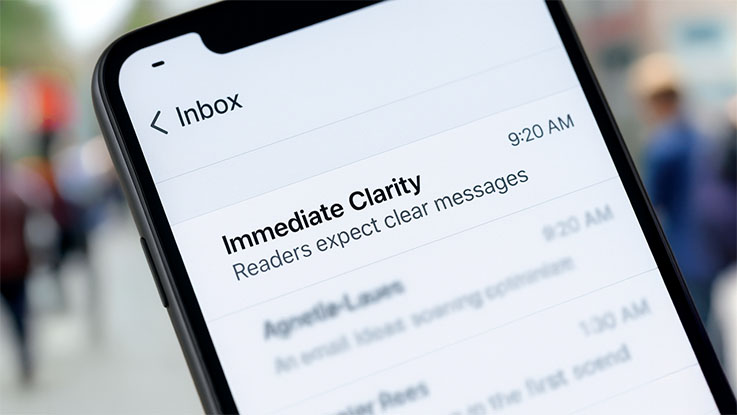
In many inboxes – particularly within LISTSERV communities – the decision to open a message doesn't begin with the content itself. It begins with recognition.
A familiar list name. A known sender. A context that is already understood.
Whether a message arrives from a research group, a professional forum or an institutional list, there is usually a reason the recipient subscribed in the first place. That original purpose – staying informed, contributing to a discussion, following a field – creates an anchor.
In that moment, the message is not a stranger competing for attention. It is part of an ongoing exchange.
Clarity still matters, but it builds on something already established.
Clarity becomes most effective when it aligns with that context.
A subject line such as "June update from the Marine Biology Research Network" works not because it stands out, but because it is immediately placed. "Agenda and notes: June committee meeting" or "New dataset available: Arctic temperature trends" follow the same pattern. They are easy to understand because they are easy to situate.
There is no need for cleverness when relevance is already present.
In this sense, clarity is not only about how something is written. It is also about how naturally it fits into what the reader expects to receive.
Much of today's advice about email is shaped by high-volume promotional environments, where messages must compete continuously for attention.
But many LISTSERV-based communications exist under different conditions.
They take place within communities where messages are expected, participation is voluntary and continuity builds familiarity over time. Attention is not captured in a single moment. It is sustained through relevance, consistency and trust.
Clarity supports that process. It does not replace it.
Reading habits are evolving, and scanning is part of that reality. Structure, pacing and thoughtful subject lines help messages remain accessible.
At the same time, the most effective communication often feels unforced. It is clear without being abrupt, structured without feeling mechanical and purposeful without trying too hard to stand out.
That balance is shaped not only by how a message is written, but by the environment in which it arrives.
Behind the scenes, reliable delivery and stable infrastructure ensure that communication remains consistent – something that has long been central to the LISTSERV platform and the communities it supports.
Clarity may be a defining theme of 2026. But in practice, it is strongest when it connects with something familiar: a known sender, a shared purpose and an established context.
As inboxes continue to evolve, this is a useful moment to reflect:
What helps your messages to not only be clear but also recognized?
Was this article helpful to you? Would you recommend it to a colleague? Your input helps us create content that truly supports your work. Thank you!


 Want More Insights? Catch up with the latest LISTSERV developments, industry best practices, expert tips, tutorials and more. |
LISTSERV is a registered trademark licensed to L-Soft international, Inc.
See Guidelines for Proper Usage of the LISTSERV Trademark for more details.
All other trademarks, both marked and unmarked, are the property of their respective owners.