In 1995, ACOR built one of the first large-scale patient communities on the Internet. Thirty years later, while the nonprofit no longer exists, the communities still do. They run on LISTSERV® and still serve patients with rare cancers who can't find peers anywhere else.
The Association of Cancer Online Resources was founded in 1995 by Gilles Frydman – three years before Google, nine years before Facebook and eleven years before Twitter. Cancer patients facing rare diagnoses had nowhere to find each other. Medical libraries were physical. Specialists were geographically clustered. Information moved at the speed of journal subscriptions and oncologist referrals.
ACOR built topic-focused email lists for specific cancers. Patients and caregivers shared treatment experiences, surfaced emerging trials, asked questions of others who had been through the same diagnosis and built trust through moderated, non-commercial conversations. By 2005, ACOR was operating more than 100 lists serving patients worldwide.
The decision to build on email rather than the web was deliberate, and it aged better than almost any architectural choice of that era. Email arrived directly. Participation was community-driven and moderated, not algorithmically ranked. Discussions were archived and searchable, preserving collective memory across decades. Communities stayed stable as participants moved through diagnosis, treatment, remission and recurrence.
Other types of forums collapsed. Social platforms frequently changed their rules. Health-focused sites pivoted to ads, then to data brokerage, then to shutdown. The LISTSERV lists kept working.
ACOR ran on LISTSERV from its early years. When ACOR was discontinued as a nonprofit, the lists could have gone dark. They didn't because L-Soft chose to keep hosting them.
"When ACOR wound down, the question wasn't whether the communities would survive. It was whether anyone would carry the archive. L-Soft did," said Gilles Frydman, ACOR's founder.
That decision is the heart of this story. A hosting partner agreed to maintain a multi-decade corpus of patient-generated knowledge with no commercial return on the principle that the communities and their archives mattered. Current list owners manage day-to-day stewardship in coordination with Frydman.
About 50 ACOR-founded lists remain active. The largest is MPN-NET, a global community for myeloproliferative neoplasms with more than 2,000 subscribers. Others cover leiomyosarcoma, bladder cancer, mantle cell lymphoma, desmoid tumors, neuroendocrine tumors and a range of other rare and complex cancers.
These are communities where focused expertise and shared experience are scarce by definition. A patient with desmoid tumors may never meet another in person. On an ACOR list, they meet a hundred.
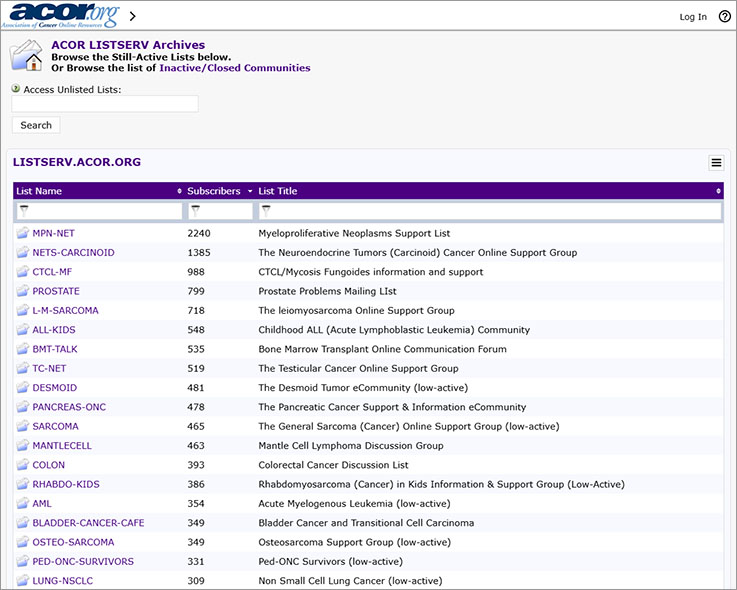
The archive itself is a singular resource. Thirty years of moderated patient discussions on rare cancers exist nowhere else, at no other scale, on no other platform. It documents how patients learned, what questions they asked, what worked, what didn't, and how peer knowledge accumulated in conditions where formal evidence remained thin.
In an era of AI systems trained on patient experience, of platform churn, of repeated failures to preserve user-generated health knowledge, the continued operation of these lists is a small standing rebuke to the assumption that online communities are disposable. They aren't, when someone decides to keep them.
L-Soft did not buy ACOR. It did not acquire the communities, monetize the archive or rebrand the lists. It hosted them, then kept hosting them after the nonprofit closed. That continuity is the product. It's what made a 1995 architectural decision still useful in 2026.
For patient communities considering where to anchor for the long term, the question isn't which platform offers the most features today. It's which one will still be there in thirty years.
This case study updates a 2005 ACOR customer profile to reflect what survived: roughly 50 active mailing lists, a multi-decade archive of moderated patient discussions, and a working example of what long-horizon stewardship looks like when a hosting partner outlasts the organization it served.
The original 2005 case study is available at:
https://www.lsoft.com//customers/acor-2005.asp
LISTSERV is a registered trademark licensed to L-Soft international, Inc.
See Guidelines for Proper Usage of the LISTSERV Trademark for more details.
All other trademarks, both marked and unmarked, are the property of their respective owners.