Recipients who use older AOL email clients (version 5.0 and older) cannot receive HTML messages, but can receive AOL Rich Text messages. AOL Rich Text is a specialized email format that uses a sub-set of HTML tags to create text formatting. Rich Text is
not compatible with newer AOL email clients, and sending Rich Text formatted mail to newer AOL clients will cause formatting errors. Images cannot be embedded in Rich Text, but Rich Text can contain links to image files located on another server.
Any trackable links in the alternative text message must be enclosed within quotation marks the same way as the trackable plain text message links are enclosed. Merge fields and drop-in content can be used in this format as described in Sections 6.1
Drop-In Content and 6.6
Merge Fields and Conditional Blocks.
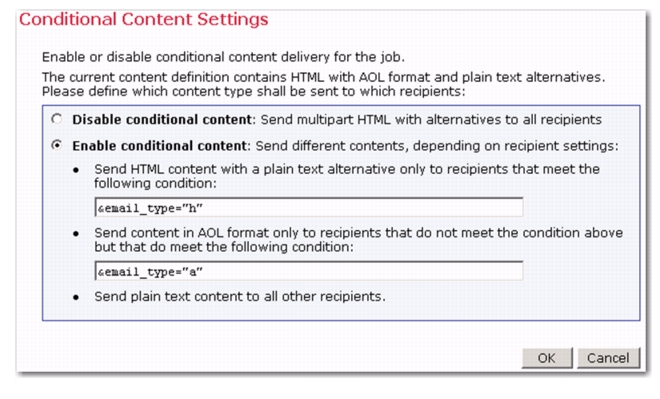
In the event that recipient data is available that somehow determines the format each recipient prefers to receive, that data can be used to send the preferred format to each recipient, all within the same job. This determination is based upon a conditional statement run against the recipient data. The advantage of using conditional content is that it’s possible to prepare a single job for recipients who prefer HTML and those who prefer plain text, respecting each recipient’s choices as well as saving time and reducing the chance for errors while sending multiple jobs.
In order to use the Conditional Content feature, it must first be enabled. To enable conditional content, click on the
Change link that appears directly under the tabs of the text box on the Define Message screen when HTML content with alternatives is selected. The Conditional Content Settings screen opens. Select the
Enable conditional content option.
Once enabled, it is necessary to type in the condition that determines which recipients receive which type of mail. LISTSERV Maestro uses the standard LISTSERV syntax to create the condition. See Section 17
Using Conditional Blocks for more information on constructing conditions. The condition needs to include at least one merge field from the recipient data so that the condition acts like a variable whose true/false result is different for those recipients receiving each of the different message formats.
There are three possible situations that conditions can be used to deliver the message format preferred by individual recipients: an HTML message with a text alternative, an HTML message with an AOL formatted alternative, and an HTML message with both a text alternative and an AOL alternative.